First of all, sorry for not posting anything so much time - as every year in june, the academical semester goes into its hot phase, accompagnied by other projects with strict terms. So the SYW-armies had to wait till Anselm, my nephew, came from US to open the annual summer battle wich has already a 4-year-tradition. Thanks to him that he took time for reading the whole rule book of "Black Powder" the night before, which we used our first time for wargaming this year.
Shortly, "Black Powder" is a rule book full of fantasy, written by experienced wargamers and made us some problems but also gaves us some enriching ideas.
We placed the tabletop into the garden, because we had 30° C sunny weather and, to reload the battle of Rossbach, the summer heat was perfect. We simplified the village a little bit and, instead of the Janus Huegel, we placed a high forest piece on the tabletop.
Enough space for having 3 different locations: the village (left), the field (center) and the clearance (right) for testing the rules and scenarios and, last but not least, enough space for our 700 miniatures, taking place in the commanded ranks.
 |
| the guy with the Frank-Zappa-haircut is Anselm (Prussians) - me in sporty shorts (French). |
We started the game with a long-during deployment:
 |
| the left wing of the first French brigade had to face the village of Roßbach, where they remark a nest of Prussians... |
 |
| a peaceful moment just before the storm |
 |
| "Fertigmachen, Jungs!" the Prussian battery is moved to its position, the hussars are rallying. |
 |
| Monsieur le Général gives the last orders, just behind them a good old Meisterzinn-Regiment (Couronne). |
 |
| the last bird´s view before the melee begun. Prussians (left and forground), French the line on the right side. |
Prussians opened the combat operations by a barefaced attack of the Green hussars "von Kleist" straight to the French artillery. The "Black Powder"-rules allowed them to do so, doing devastations in the French lines without any excuse!
 |
| I have to mention the good Prince-August-Pikeneers (Piemont) - they will sweep into the cavalry´s flank next... |
 |
| same scene, from the artillerists´ point of view - oh mon Dieu, restez calmes! |
 |
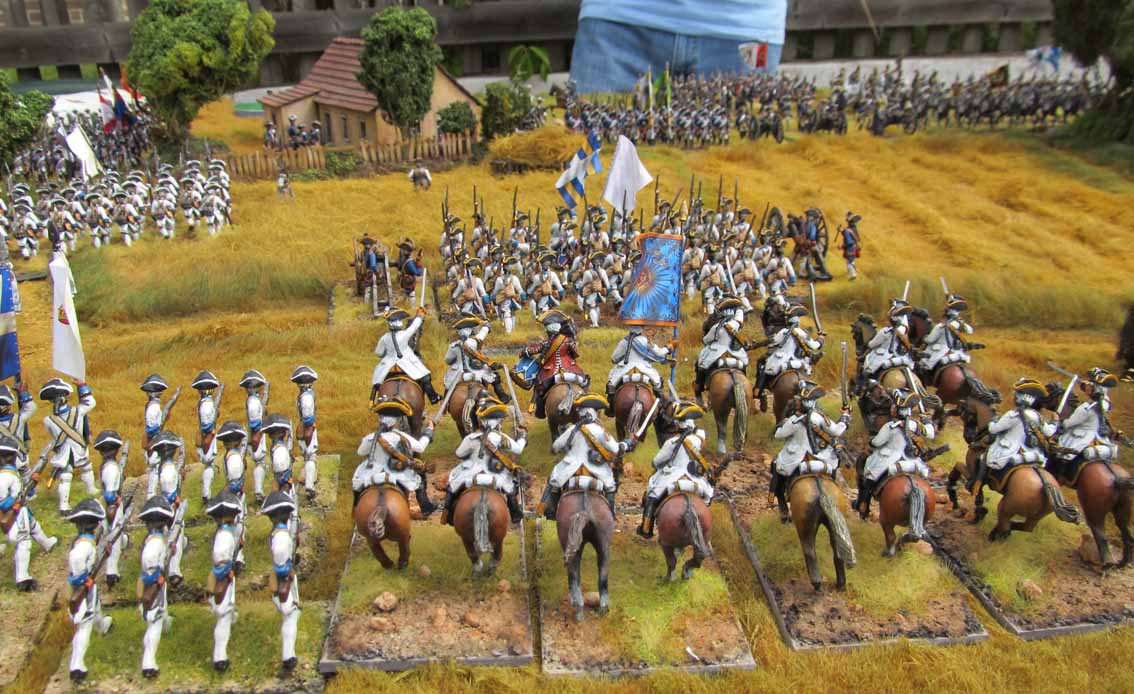
| The French artillery was victorious, the Kleist hussars retired. The moment was good for a broad advance operation as counterattack in the center. Regiment Flandres with 2 battalion guns, followed by Commissaire Général cavalry (both Sash&Sabre). |
At the same tme, the French advanced on their right wing with 4 cavalry regiments with the order to overwhelm the week Prussian units behind the forest:
 |
| view to the right flank. Prussians are waiting an attack; not visible. The Prussian Jaegers, hidden in the forest and operating as snipers (Scharfschützen). They benefit a lot of the rules... |
 |
| French cavalry in its best form: Mestre de Camps Général (Sash&Sabre), Mousquetaires du Roi (Prince August) |
 |
| En avant, garcons! The Prussians has some really hard moments... |
 |
| The regiment No35 (Front Rank), a battalion gun and some Manske-Jaegers awaiting the French thunder.. |
 |
| Haltet hoch die Fahnen! |
 |
| Prussian Jaeger (Manske) loading |
 |
| The attack was victorious, but the French paid a high price: they lost one heavy cavalry regiment (du Roi). Enclosing the Prussian regiment No 49, some brown hussars (Fleischhacker) break in their flank.. |
 |
| The Brown hussars (Manske miniatures) |
 |
| The French Brigade commander is nervous... |
The French cavalry could break the Prussian resistance on this wing, but were not able to move further: Seydlitz commanded a second defensive line.
Meanwhile, the Prussian center launched a second attack, this time by Cuirassiers "Garde du Corps", pushed aside the Commissaire Général and were just intercepted and enclosed by the French infantery "Auvergne" and "Couronne".
 |
| same scene, view from above. The French infantery suffered under heavy casualties. |
 |
| The Cuirassiers are pushed back - here a view from behind the Prussian lines, as Seydlitz could see that (he is in the center of the image). |
 |
| Pikeneers and Swiss "Lochmann" supporting the cavalry. |
 |
| last attack of the French before they defeat the 2 Prussian Cuirassiers regiments. |
 |
| The victory seems to be so close... |
 |
| But the Prussians never give up. They mobilized all the reserves, coming out from the village of Rossbach and advancing against the French center. |
 |
The were successful in 2 turns: in combination with 4 guns and 3 regiments they were able to erase all the French infantery - left alone the commanders and 1 cavalry regiment behind the forest.
Victory for Prussia, nonetheless it was not Seydlitz this time. Mes compliments, Monsieur le Roi de Prusse. |
You can see it at the moving shadows on the tabletop: we wargamed 4 hours. 50% of the time we lost by throwing dices and counting, but it was a fine and terrible, respectable and merciless battle.
Thanks, Anselm!