About


Wargaming the Seven Years War with 40mm miniatures, done by: Johann-Peter Scheck and Anselm Scheck

Wednesday, September 14, 2011

Saxon Artillery repainted


Okay, I will be honest: at the fair at Kulmbach I found a fascinating book about the Saxon Army in the 1730s, written and edited by the former east-german military editor: Militärbuch-Verlag der DDR; the book´s name is "Die Armee August des Starken".

In this book there is a complete list of the Saxon Artillery stuff and illustrations. I immediately changed the colour of my artillery and train from the green into the black-brown with yellow metal fittings. But how to know the exact tone of yellow painted metal in the 18. century? I browsed on some pages about Saxony and found this:
source: www.sachsen-bilder.de


This cannons are part of the museum on the Burg Königstein in Eastern Saxony. I never believe in this light yellow and heavy contrast and decided to follow other sources.

On a painting of Canaletto at the city of Meissen, I found two examples, see here:


After comparing this painting with the book of the military archive of former GDR, I decided to use a more dark and ochre-orientated yellow for the metallic parts. In 2 nights I repainted then my whole Saxon Artillery...
See here the result:

The new black-yellow guns with staff

The riding drivers had different uniforms: here carrying a mortar


I also lightened the green uniforms.


And, as usual, here the official Artillery´s flag:

To download, just pull the image on your desktop: the size is scaled for 40mm figures.


Saturday, September 10, 2011

Saxon Grenadierbataillon Kurprinzessin


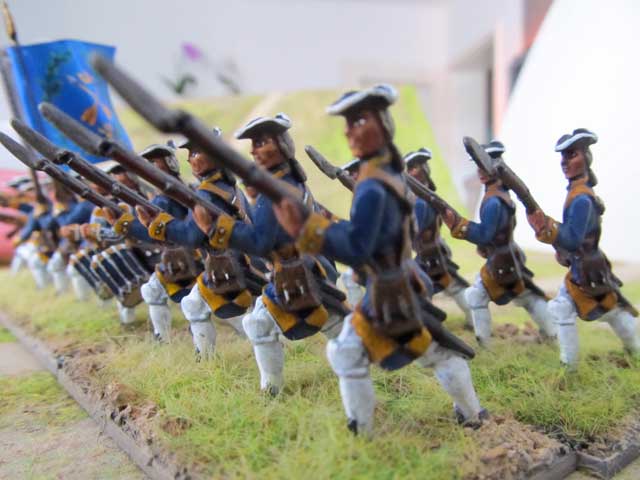
Dear followers, first my excuse for long-time silence, but maybe you know it also: the professional life absorbes sometimes a lot of energy and time. In the meanwhile I couldn´t produce as much as I would, but I have some news: today I start with the first part of four about my Saxon army. You see my grenadeer bataillon "Kurprinzessin", which got the name of Maria Antonia Walpurgis, Kurprinzessin von Sachsen. I like this regiment very much because of their seldom colour of a grey-blue, called bleumourant (a french fashion colour at this time: a "dying blue" what you see in the evening at the late sunset).
The figures are from Prince August and token from the Rossbach-serie. I like this moulds because of their high relief-quality, nevertheless they are semi-flat figures.
The standrad-bearers are from NMZ, the flags are selfmade in the computer after a long-during research of sources.
In the next post I will present you the renovated saxon artillery with some templates of uniforms.


You can see that not every figure came entirely out of the mould - they are some small mistakes. Honestly, a part of the regiment consists of old figures, which I repainted .


Colonel´s flag

Regimental flag


Thursday, August 25, 2011

Tin figures fair at Kulmbach 2011


The weekend of the 13th-14th august we were pilgrims to the tin figures fair at the small city of Kulmbach, nortehrn Bavaria. This is the biggest fair in Germany, happening every second year in august. We found a lot of manufacturers from whole Europe, new for me were the polish ones from Krakow: Krakus figures: www.figurines.com.pl
They fabricate excellent figures in the scale of 54mm, Thomasz Kusion introduced me in his work.
Shortly said, there wasn´t a lot of our preferred scale of 40mm, it seems that this is not the trend in collecting. Only Matthias-Manske had a big desk with hundreds of marvellous figures, where I bought immediately a batallion gun with crew for my saxon army, which is under construction on my table...
What you see on the pictures are the figures of the saxon manufacture of Peipp; wonderful figures, excellently painted and posing in very funny ways. I like them and would wish to combinate them with our 40mm armies, but also here, the scale is different: the exposed Peipp figures were in 54mm. But at the homepage, I found some figures in 45mm, with this typical, very expressive faces, see here:
http://www.peipp-miniaturen.de/shop/45mm_figuren.php

So, a wonderful weekend with a lot of impressions.


Mademoiselle Anush is as fascinated by the figures as her father...


An afternoon at the fair is quite tiring; Mademoiselle Anush and her sweet Tatar mom.


Monday, August 22, 2011

Swedish Regiment Dalarnas


This is one of the nicest results of our big sumer battle in Switzerland; my brother Felix starts also collecting tin soldiers and he focussed his emphasis to the swedish army during the SYW. As beginner, we decided to do most of the figures with moulds from Prince August - easy to do and faster to paint as others.
Which you see is the regiment Dalarnas, one of the swedish provincial regiments. We are still not sure, which tone of yellow Sweden used during the SYW: if you see at the swedish-russian reenactments, the yello is clear like a sunflower yellow. If we look at older sources (Knötel and others), we see a more curry-yellow. The second one is our preferred choice.
You can see the less details at this figures, thea are also smaller and thiner than other collections.
Thanks to Steve Cady who gave me the link to Prince August´s new edition of pikemen, we will order now this 2 moulds and complete a swedish phalanx: not really up-to-date to the SYW, but very efficient in our battle games against cavalry.
The flags I did in Photoshop, using some basic symbols found at swedish sites and built the details and shadows myself.


Tuesday, August 9, 2011

New book edited: Der Weg nach Leuthen -The Way to Leuthen


This is the reason for my absence the last days: Matthias Manske, the Manufacturer of figures, wrote a manuscript some years ago about the background of the battle at Leuthen 1757. He also built a quite impressioning diorama with hundreds of figures.
I offered him to layout this manuscript and to edit a book. A research of old maps, sources, images began and we completed the book now this week.
Manske writes in an exciting way about the the role of Prussia in the early 18th century and puts focusses also on Great Britain, France (including the consequences of the SYW to the french revolution), Austria, Russia and Sweden. The battle reports of Kolin, Roßbach and Leuthen are described in details and explained from different points of view.
A lot of maps from the digital archive Marburg and pitcures of tin soldiers complete the book.
See here some extracts of the book:


You can buy the book at Matthias Manske: matthias.manske-zinn(at)web.de

Tuesday, July 26, 2011

The Rules of our game

After the nice posts we got concerning our summer battle with the question, which rules we use, we decided to post them here. Scheckinator helped me to translate our self-made rules in english. They are very simple and easy to understand and use:


1. Nature of the Game

The game is oriented towards the battles of the SYW. Mobility, tactics, and speed are imitated as closely and realistically as possible to resemble the original mid-18th century combat we’re trying to emulate. There are only a few situations that rely on the element of chance (e.g. throwing dice), the majority is according to your own decisions and the power and skills of your army. The game also has an offensive emphasis.


2. Basics

A. Deployment
There is a defending army and an attacking one. The defenders place their forces, consisting of artillery, cavalry and infantry, first and occupy the best available position. Then the attackers place their army.

B. Movement
The attackers have the first move.
A move signifies that every unit in the army can be moved simultaneously. So the whole army can be moved.
The rules for moving are:
infantry: 1 field (10cm | 1/3ft)
cavalry: 3 fields (30cm | 1ft)
artillery: 1 shot or move 1 field or turn (only if more than 60°). Shooting and moving at the same time isn´t possible.
If you have a limber, move the cannon/mortar also 30 cm.

infantry and cavalery can move AND fire simultaneously.

Then the enemy moves and so on.

C. Shooting
If a regiment approaches another one at a distance of 1 field, they can open the fire.
You take dices with as many points as your regiment has soldiers and throw dice. The enemy does the same. The difference of the results marks the losses. Remove the bases that have been killed.
# Background of this rule: muskets were fairly inaccurate during this time period

If you have grenadiers in your regiment, 2 of them can throw a hand grenade.
They can be thrown and kill 2 enemies each.

For the cavalry, the points are as follows:
light dragoons 2pts/man
heavy dragoons 3pts/man
hussars 2pts/man
cuirassiers 2pts/man
# idea: cavalry had more guns or side arms to fire

D. Melee
If a regiment touches another, the close fight begins.
Count your soldiers and the ones of the enemy by their skills - the difference marks the losses.
# background of this rule: well-disciplined soldiers fight better than recruited troops.

Skills:
musketeer/fusilier          1 pt/man
grenadier                 1,5 pts/man
pikeman                0 pts/man vs. infantery, but 2 pts/man vs. cavalery
officer                   2 pts/man
musician/standard bearer 1 pt/man

dragoons 2pts/man
hussars             2pts/man
cuirassiers         3pts/man

If you have grenadiers in your regiment, 2 of them can throw a hand grenade.
They can be thrown again and kill 2 enemies each.

## Example:
1 grenadier regiment fights with a musketeer regiment; both consist of 25 figures.
Count grenadiers: 24 soldiers and bearers + 1 officer = 36+2 = 38 pts.
Count musketeers: 24 soldiers and bearers + 1 officer = 24+2 = 26 pts.
Result: Take 12 musketeers away.
Same to all other fights.


3. Special effects

E. Cavalry´s special attack
If there are 1 or 2 fields between the cavalry and the enemy, the cavalrymen can accelerate to gallop and move into the infantry´s rank. Hereby the center of the infantry will be pushed back 1 field and 4 infantrymen were trampled to death and killed.
If you no longer have complete regiments, count: 3:1 (3 cavalrymen kill 1 infantryman).
Then start to count the skills (see D).
# Background of this rule: The cuirassier-effect of Seydlitz at Kuehnersdorf against the Russian lines, where the cuirassiers trampled the Russians to death.

F. panic and Retreat
If a regiment is being attacked by the enemy and thinks it will lose, its officer can decide to retire 2 fields (flee or panic). The next turn the regiment may not move because it has to reorganize.
# Background of this rule: The panicked retreat of the French at Rossbach.

G: artillery shooting
The cannon fires 5 fields and kills at close range: 3men / wide range: 2men
The mortar fires 4 fields and kills 3men
wider range: To hit the planned target, you must roll a die.
If you roll a 1 or 2 you’ve hit the field to the left, a 3 to 4 is a direct hit, and a 5 to 6 is a hit on the field to the right.
You need 2 hits to destroy a cannon or a mortar by artillery.
The mortar needs only 1 shot to destroy a cannon.


4. End of the game

The winner is the side that:
- takes the enemy general captive
- or forces the enemy general to give up
- or conquers 3/4 of the battlefield´s territory


Wednesday, July 20, 2011

Summer Battle at the Bünz river 1761/2011

French regiment La Couronne advancing in the foreground, assisted by the Mousquetaires du Roi, the Gens d´Armes Bourguignons, the infantery regiments Auvergne and Orléans.


The long expected moment of the big family wargame arrived last sunday and we met in my sister´s house in Switzerland, near the river Bünz. It was a great highlight to see again all relatives and to roll out then the battlefield on the floor and place the armies.
This were the allies: France and Prussia vs. Russia and Sweden. Saxony was not involved in this battle.
The opponents were inequal in weapons and manpower:
The more infantry vs. the statical power of artillery.

France and Prussia were the mobile part with more infantry but less artillery:
11 infantry reg., 7 cavalery reg, 5 16-pounders, 3 24-pd-mortars - totally 375 men

Russia and Sweden had a big artillery fraction, but less infantry:
9 infantery reg, 7 cavalery reg., 9 16-pounders and 7 24-pd-mortars - totally 330 men

Will the difference of 10% more manpower be equal to the big advantage of artillery fire?

I have to introduce our army disposition: we played with our old Prince August figures, in combination with NMZ figures, Sash+Saber and Matthias-Manske.
As you can see at the pics, its a great, mixed ensemble of figures! I could animate my younger brother Felix to start wargaming 3 weeks ago -  he leads now the small swedish corps of P.A.-figures.
r.a. 700 men rolled out at the beginning of the battle, in addition 60 men at the artilery.

To say it immediately: there were a lot of intensive discussions...


The opening was an aggressive attack of the french infantry in the center against russian grenadeers and hussars. It was supported by a long-during, heavy artillery-fire. The french used the pikeneers from the Spanish War of Succession in the first rank and could in this way hold the russians on distance... for a while.
Heavy fire from french cannons gave the sound to the first attack


On the opposite:  russian hussars of the Slobodskii regiment, flanked by the 1st grenadeer regiment and some ulans - also visible: the blue-yellow swedish corps


On the right flank, the prussian regiments No 1, 13, 18, 34 and 49 prepared a second attack against the russian infantry. They should be assisted of the brown hussars No 6 "Fleischhacker". Unfortunately the russians positioned 4 heavy mortars directly behind the first rank, so it would be a kamikaze-like movement to attack them.
Prussians had to wait till the artillery could destroy from distance mortars and reduce the infantry power - a long-during fire began, but over 3 hours, it was no movement on the right flank.

Russian Manske-Linegrenadeers and Permskii regiment under prussian menacement. 
In the center, a counter-attack by the russian cavalery against the french center initiate a bloody fight between the french main-army and the russian right wing: this fight killed in the following 3 hours 5 french infantry regiments and 1 cavalery regiment, on the russian side 3 infantry regiment, 2 cavalery regiments and 5 12-pounders. It was the most cruel part of the battle.
The russian "contre-attaque" against the heart of the french killed r.a 240 men...
Russians kept the fortified "Geschützstellung" with mortars and bombed on the french center.
French and Prussians were concentrated to destroy the ennemy´s artillery hegemony by heavy and perpetual artillery fire. They kept the cavalery in the second and third rank to protect them against bombardements. They were needed for the finale coup.

Then, after the bloody fight in the center, prussians and french cavalery comes together in the right center and were united.
Cavalery attacks in the right center.
The cavalery´s hammer of 2 prussian Cuirassier reg. and 2 french Cuirassier reg. came down upon the russian and swedish center: this attack was so heavy that the whole russian and swedish cavalery were killed - the prussian Cuirassiers took advantage of their supreme tactical manoeuvres and the power of weapons and discipline. The majority of them also also died during this attack - but it was final beat for victory and the end for the ennemy - great Prussians!
Preparing the cavalery´s attack: french Cuirassiers du Roi, prussian Hussars and Cuirassiers.
Now, the way was open for the prussian right flank to purge the rest of the swedish and russian infantry.
After this attack the russian General Apraxin had no more protection by his troops - he had to flie - but where to go? The french Mousquetaires du Roi came from the left side, the prussian Cuirassiers from the right....
The end of the battle: General Apraxin (from Matthias-Manske) in the center left couldn´t move in any direction - some russian dragoons (foreground) came too late: french Mousquetaires (left) and prussian cavalery (background) came closer and closer...
The russian General gave up...
The map of the battle:
A french light attack against the russian light cavalery
B Attack of the russian center and right flank against the heart of the french lines. Prussian infantry moves in a bow to cut the russian lines.
C The finale cavalery´s attack by prussians cuirassiers and french support. They prosecuted and enclosed  the General Apraxin (red square) at the end of the battle

green: russians; yellow: swedishs; blue: prussians; lightblue: french; black: artillery